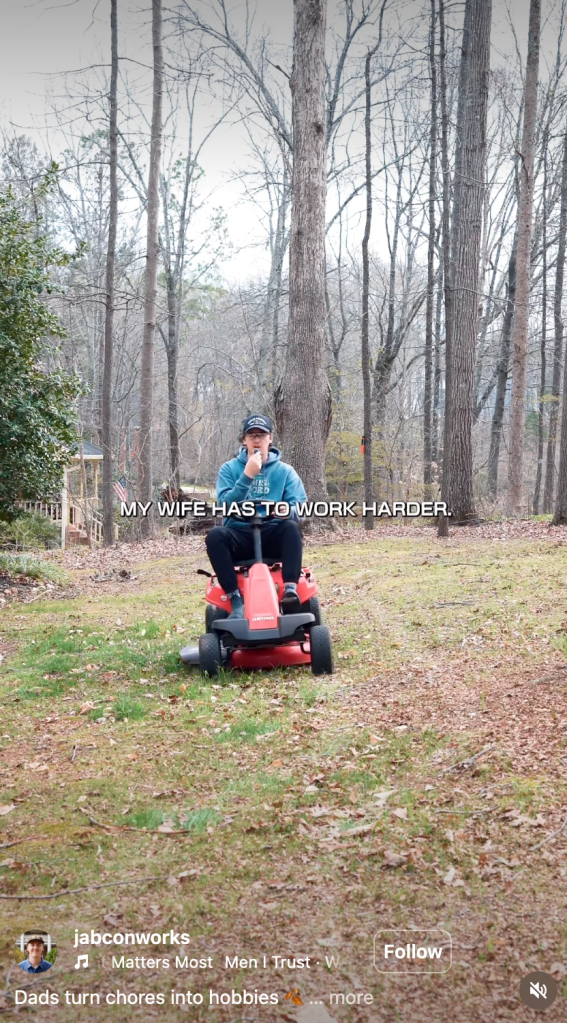
There’s a video making the rounds right now of a guy on a riding lawn mower, talking to the camera about the classic dad stereotype: we turn chores into hobbies.
We mow the yard, and somehow that becomes our thing. We fire up the grill, and suddenly we’re a pitmaster. We fix the leaky faucet, and we’re basically a contractor. These are our “hobbies.”
And here’s the uncomfortable truth buried in that observation: dads have quietly accepted that the only me-time we’re allowed is time that still benefits everyone else.
The moment you want to do something that’s just for you? Like go to a D&D night, or join a recreational sports league, or disappear into a woodworking project for three hours on a Saturday? Suddenly, it feels complicated. Now there’s a negotiation. And, of course, there’s guilt.
That guilt is real. It’s worth talking about where it actually comes from.
We Absorbed the Message That Good Dads Are Selfless
From a pretty young age, the cultural script around fatherhood is about sacrifice. A good dad provides. A good dad shows up. A good dad puts the family first. There’s nothing wrong with those values at their core, but somewhere along the way, “putting the family first” got distorted into “your needs come last.”
So when you carve out two hours on a Tuesday night to go do something you genuinely love, some part of your brain flags it as a betrayal. Even if your partner didn’t say a word. Even if your kids are in bed. The guilt shows up anyway, because you’ve been running on a belief system that says your enjoyment is a luxury the family can’t afford.
That’s the message worth interrogating.
The Chore-As-Hobby Loophole
The reason dads lean so hard into grilling and mowing and home improvement as their “hobbies” isn’t just because those things are genuinely satisfying (though they can be). It’s because they come with built-in justification.
Nobody can accuse you of being selfish when you’re mowing the lawn. You’re contributing. The yard looks great. The family benefits. Your enjoyment of it is almost incidental.
But sign up for a pottery class? Go to a hockey game with your friends? Start a podcast about a niche interest nobody else in your house cares about? That’s harder to defend, even though there’s nothing to defend. The absence of a tangible family benefit suddenly makes it feel indulgent.
This is the trap. We’re so conditioned to justify our time in terms of usefulness that purely restorative hobbies feel illegitimate.
The Partner Dynamic
The video also touches on something real: when a dad wants to step away for a personal hobby, it often falls hardest on his partner. If she’s also parenting, also working, also managing the household, then one person stepping out for non-essential personal time can genuinely create an imbalance.
That’s a practical problem worth taking seriously. But it also creates a cycle where dads preemptively abandon their own needs to avoid putting that pressure on their partner, and their partner may not even know it’s happening.
My wife has said to me many times, “if it makes you happier and helps keep you fulfilled and kind, then it’s not selfish – it’s for us all too.”
She’s right. A dad who is burned out, resentful, and running on empty isn’t a gift to his family. A dad who has something that genuinely lights him up, who gets enough breathing room to remember who he is outside of his responsibilities, brings more warmth and patience to the table. That’s not a small thing.
The conversation worth having with your partner isn’t “can I have this?” It’s “how do we each make sure we’re getting what we need, so we can both show up well for this family?”
Where the Guilt Actually Comes From
A few honest sources:
You don’t have a great model for it. Depending on how you were raised, your own dad may not have had visible hobbies separate from family life. Or he did, and he was absent in ways that hurt. Either way, the template you inherited might be working against you.
You’ve tied your worth to your output. If you feel most valuable as a dad when you’re doing, providing, fixing, or solving, then sitting with a hobby that’s just for enjoyment triggers a subtle identity alarm. Who are you if you’re not being useful right now?
The guilt is easier than the negotiation. Having an honest conversation with your partner about what you need takes courage and vulnerability. Quietly sacrificing your interests and stewing in low-grade resentment is emotionally cheaper in the short term, even if it costs you more over time.
What You Can Actually Do About It
Name the hobby out loud. Something shifts when you stop treating your interests like a secret or an embarrassment. Tell your family what you’re into. Let your kids see you care about something just because you care about it. That’s a genuinely valuable thing to model.
Stop requiring your hobbies to justify themselves. Mowing the lawn is a chore. If you love it, great. But you’re also allowed to love things that don’t cut the grass. Both can coexist.
Have the actual conversation. If the barrier is a real logistical tension with your partner, talk about it directly instead of assuming the answer is no. You might be surprised. Most partners don’t want a hollow version of the person they chose. They want the real one.
Start small and protect it. You don’t need a massive block of time. Even an hour a week doing something that’s genuinely yours builds something important. And once you have it, guard it. Don’t let it be the first thing you cancel when life gets full.
The guy on the lawnmower is funny because it’s true. But the observation underneath it is worth sitting with. We’ve built a culture where dad’s “me time” is only acceptable if it comes with a utility function. And a lot of us have quietly internalized that.
You’re allowed to have a hobby that doesn’t feed anyone, fix anything, or mow a single blade of grass. Not because you’ve earned it. Just because you’re a person.



 Socialdad.ca
Leave a comment