Governments around the world have decided they’ve had enough. In the past three months, legislation banning children from social media has moved faster than almost anyone predicted, and parents everywhere are watching closely, wondering whether any of it will make a real difference at home.
Australia became the first country to introduce a general social media ban for under-16s, which took effect on December 10, 2025. The government’s stated goal was straightforward: give children their childhoods back. Protect them from cyberbullying. Get them off their devices.
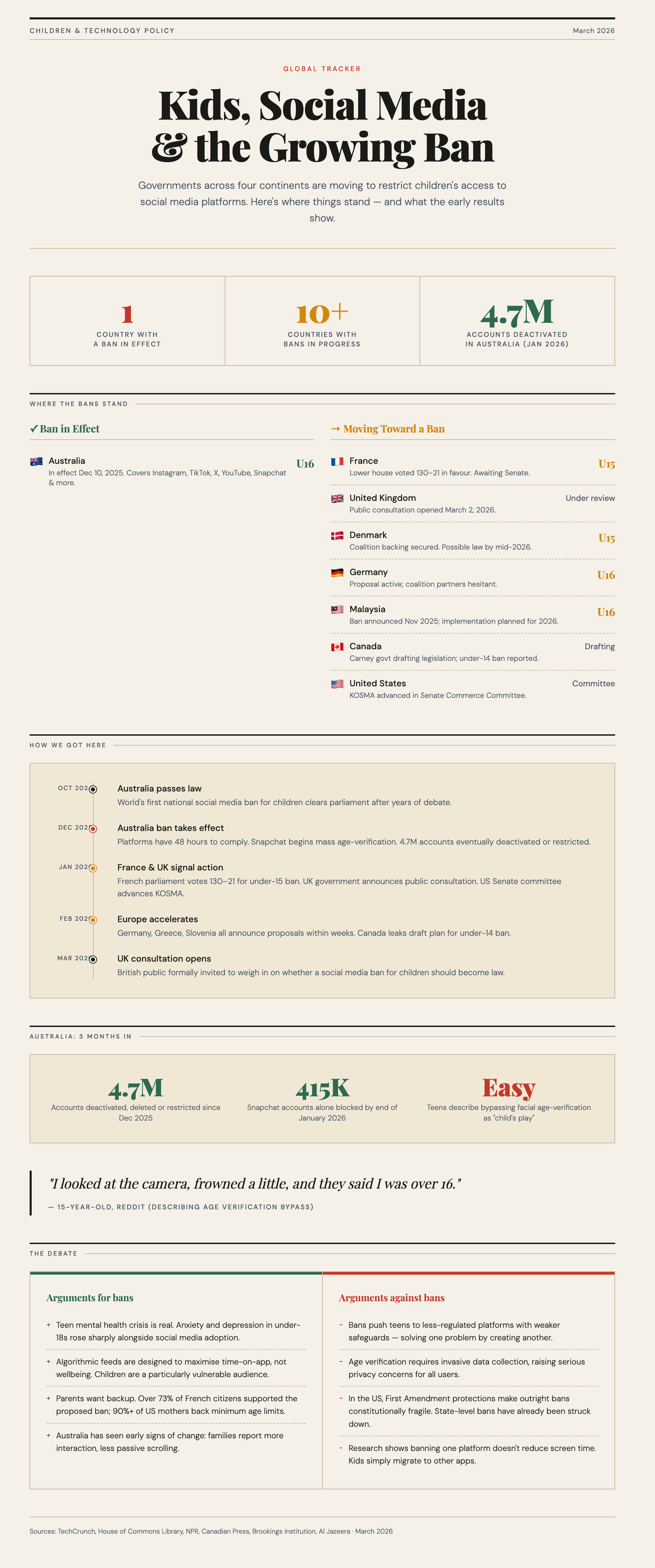
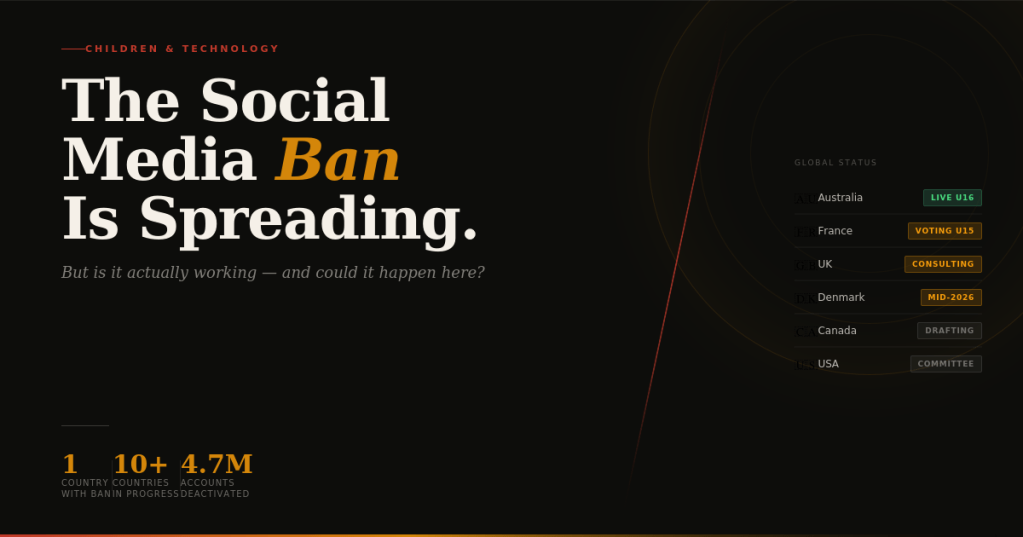
Now the idea is catching on everywhere. France’s lower house of Parliament voted 130 to 21 in favour of banning children under 15 from social media, with President Macron calling it a “major step.” Denmark is pushing for a similar ban for under-15s, with legislation potentially becoming law as soon as mid-2026. Germany, Greece, Malaysia, and Slovenia are all moving in the same direction. In the UK, a government consultation on children’s social media use opened on March 2, 2026, and is specifically seeking views on whether an outright ban is warranted.
For parents who’ve spent years trying to pry phones from teenagers’ hands, this feels like a long time coming.
What’s Actually Being Banned
Worth clarifying, because the headlines can be vague. Australia’s ban covers Facebook, Instagram, Snapchat, Threads, TikTok, X, YouTube, Reddit, Twitch, and Kick. WhatsApp and YouTube Kids are excluded. Social media companies that fail to keep under-16s off their platforms face penalties of up to $49.5 million AUD.
In the US, Congress is pursuing a different approach. The Kids Off Social Media Act prohibits platforms from allowing children under 13 to create accounts, requires deletion of existing child accounts and their data, and bans platforms from using algorithms to push personalised content to anyone under 17. That last part matters. It targets the engine that makes these apps so consuming: the recommendation system that learns exactly what keeps a child scrolling and keeps serving it to them.
The Results From Australia Are Complicated
Three months in, Australia offers the first real evidence of what these bans actually do. The government reports noticeable changes, with Prime Minister Anthony Albanese pointing to young people getting off their devices during the Christmas school holidays, reading more, going outside, spending time with family. More than 4.7 million accounts belonging to children had been deactivated, deleted, or restricted by January, with Snapchat alone blocking 415,000 accounts.
Parents report something different on the ground. “I have twins, and nothing significant has changed,” one frustrated mother wrote on Instagram. “Most of them were back online straight away and created new accounts.”
The technical workaround problem is real. A 15-year-old described defeating facial recognition age verification by simply frowning at the camera. The verification systems designed to enforce these bans are not particularly hard to fool right now.
Could This Happen in the US or Canada?
The short answer: possibly, but not soon, and not in the same form.
United States
The US already has legislation moving through Congress. The Senate Commerce Committee voted to advance the Kids Off Social Media Act (KOSMA) in early February, bringing it closer to a full Senate vote. The bill has genuine bipartisan support, which is no small thing in the current political climate.
What it proposes is more targeted than Australia’s blunt instrument. KOSMA prohibits platforms from allowing children under 13 to create accounts, requires deletion of existing child accounts and their data, and bans platforms from using automated recommendation systems to push personalised content to users under 17.
But the US has a complication that Australia doesn’t: the First Amendment. Any federal restriction on access to online platforms intersects with First Amendment protections for speech and association. Courts have previously struck down or narrowed laws that overly restrict minors’ access to online content. The ACLU has been direct about its opposition. Civil liberties groups argue that KOSMA would unconstitutionally infringe on minors’ rights to access and share information online and that a ban, as opposed to mandating appropriate safeguards, infringes on First Amendment rights.
Supporters push back on that. First Amendment experts supporting the bill argue it doesn’t censor protected expression on platforms; rather, it targets the procedures and permissions that determine the time, place, and manner of speech for underage consumers. They compare it to existing age restrictions on tattoos or alcohol. The constitutional debate will likely end up in court regardless of whether the bill passes.
States haven’t waited for federal action. Florida banned children under 14 from certain social media platforms, though the law was quickly challenged. Utah, Texas, Arkansas, and Louisiana have attempted to require parental consent for minors to have accounts, and all faced legal challenges. California and New York took a different approach, seeking to regulate “addictive feeds” for minors without parental consent. The patchwork of state-level efforts, most of them tied up in litigation, illustrates exactly how hard this is to do in the American legal environment.
Canada
Canada is further behind, though frustration with that delay is growing. For nearly half a decade, Parliament explored measures to protect children online. The Trudeau Liberals introduced an online harms bill in February 2024, but it never made it past second reading and died when the 2025 federal election was called.
Canada currently has no social media ban for children. The terms of service for major platforms say users must be at least 13, but as one McGill University expert put it, this “isn’t particularly meaningfully enforced by the platforms.”
Under Prime Minister Carney, there are signs of movement. The Globe and Mail reported the government had drafted a plan for a social media ban for children under 14, and the government confirmed it’s working on new online harms legislation. Advocates aren’t satisfied with the pace. “We do not need more studies and we do not need to debate whether social media is a problem for children. We already know the answer,” said Sara Austin, CEO of Children First Canada, before a parliamentary committee in February.
The structural difference between Canada and countries like Australia or France is less about political will and more about legislative history. Canada lost two years to a bill that stalled. It’s now starting again, and online harms legislation rarely moves as fast as anyone pushing for it would like.
What both countries share is a public that broadly wants something done. The politics are aligned. The legal and technical path is just considerably messier.
What This Actually Means for Parents
Here’s the tension. For parents who want their kids off Instagram and TikTok, government bans can feel like welcome backup. But the evidence from Australia suggests the ban works best for the children who were already less tech-savvy, or whose parents were already enforcing limits at home. The teenagers most deeply embedded in these platforms found workarounds quickly.
Critics of outright bans say they could force children into less-regulated online spaces where they face greater risk, require intrusive age-verification systems, and raise serious questions about free expression. Those aren’t fringe concerns. A teenager who can’t access Instagram through the front door will use a VPN, create a fake account, or migrate to a platform with fewer safeguards.
The French legislation took a slightly different angle. A French lawmaker who presented the bill told Parliament that “our children are reading less, sleeping less, and comparing themselves to one another more” and framed the law as “a battle for free minds.” That framing resonates with what many parents already see in their own homes.
The Harder Conversation
Legislation or not, parents are still the first line here. A government ban can change the default, shift the norm, make it easier to say no. What it can’t do is replace the conversation you have with your 13-year-old about why these platforms are built to be addictive, what it feels like to compare your life to a highlight reel, or why your real friendships matter more than your follower count.
Under the US Kids Off Social Media Act, children would still be able to search for content and follow channels of their choice. The key restriction is on algorithmic promotion: platforms could no longer use machine learning to identify what keeps each individual child on the platform longest and repeatedly push that content at them. That distinction is worth explaining to your kids. The problem with social media isn’t the content itself. It’s the invisible system designed to keep them there past the point where they’d naturally stop.
Whether the bans work or not, that conversation is still yours to have.


 Socialdad.ca
Leave a comment